Archive for the ‘collaboration’ Category


Event with Eliska Zakova and Rebecca Stephany

June 4, 2013 posted in collaboration, events, projects, research
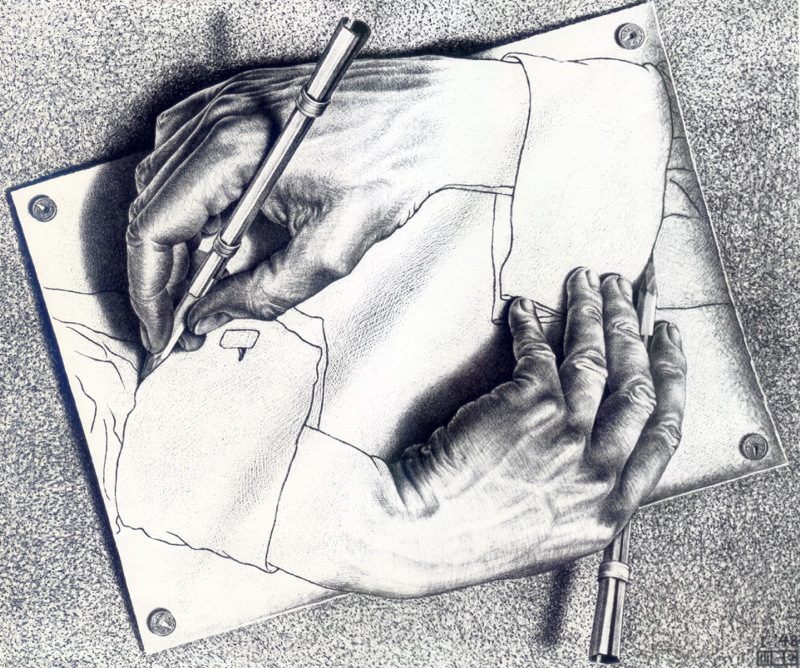
M.C. Escher, Drawing Hands, 1948

Thursday 13th June at 19.00h

Entrance fee: €3

Within the framework of  ARTIST4ARTIST – The Economic Performance, over the course of two evenings, together with the invited contributors and the audience Upominki peels back the layers and networks of the economy while trying to scrutinize the artist and arts worker.

The second event in the series focuses on the “artist-gallerist” relationship and is set to explore its dynamics, expectations and alternatives in the context of the art world and its inevitable network structure. While introducing the various types of galleries and their position in the “art eco-system”, the conversation aims to practically address the unspoken rules and strategies related to artists’ career building and their relationships with gallerists. Coming from different sides of the field, Eliska Zakova and Rebecca Stephany will represent opposite standpoints in this conversation.

Eliska has a background in art history and art management and mainly works with commercial art galleries. She will advocate for the model of the “commercial gallery” and their irreplaceable role as catalysts in the art world. She will try to explain how these galleries contribute to the creation of artistic reputation and value, and how/ to what extent they impact an artist’s way of working. Comparing the sphere of fine arts with the music scene, Eliska will argue that it is much harder to avoid art dealers as mediators in the art industry than it is to exclude them from the music industry.

Rebecca is a visual artist-cum-designer-cum-educator, currently working beyond (or without) the collaboration with a commercial gallery. She will advocate for an emancipation of the notion of a successful artistic practice from working with a gallery. Considering the potential of alternative and self-empowering models of building a career and sustaining one’s professional development, Rebecca will bring into discussion the notion of the artist run gallery and various models of non-gallery-yet-institutional-career-practices, such as “the biennial artist”, “the residency artist” or “the project-based artist”, especially regarding the increasing importance of community-building and collaboration in the light of economic crises and budget cuts.

Eliska Zakova (1984, CZ) studied Art History and Art Management in Prague, Berlin and Utrecht and currently works as an assistant at Galerie Christine Mayer in Munich. Through her previous positions at Galerie Ben Kaufmann and other commercial art galleries, she developed a theoretical interest in the art world’s structure and functioning, especially in the role promotion galleries play in it. In her latest research, she has been exploring networking-based strategies for gallerists to promote young, cutting-edge artists, taking social network theory as a point of departure. She specialises in modern and contemporary European art and occasionally curates exhibitions at the K4 Gallery in Prague, an independent contemporary art space that encourages collaboration between art students and young curators.

Rebecca Stephany (1980, DE) lives and works in Amsterdam, The Netherlands. Having a background in art and graphic design, and being an educator in both fields, Stephany’s practice is reluctant to the categorization of cultural practices, especially in the field of art and design. Stephany makes use of the unspoken rules, expectations and agreements at work in the attempts of differentiating art from design. In doing so, Rebecca’s practice takes many forms, appropriating styles, disciplines and qualifications as needed. Her work includes installation, video, performance, sculpture, writing, self-publishing to performative lecturing. In 2010 and 2011, Stephany was research resident at Rijksakademie in Amsterdam. Rebecca Stephany has taught at the graphic design department of Gerrit Rietveld Academie since 2007. In spring 2013 Stephany was resident artist at CCS Bard (Center for Curatorial Studies) in Upstate New York. In 2010 The Museum for Contemporary Art in Leipzig awarded her the Inform.Award, a distinction for conceptual design.

About the project: 
ARTIST4ARTIST – The economic performance (2 April – 30 June 2013) is a collaborative project between Upominki, Artist4Artist platform and Jesse van Oosten, made possible with the kind support of Gemeente Rotterdam. For more info about the project please go to A4A. The public program is developed in collaboration with Eloise Sweetman.

The educational program Brave girls sing! Walk taller, speak louder is made possible with the kind support of Het Rotterdams Vrouwenfonds.


 

Tags: , ,


Event with Andrew Varano and Jessica Sligter

May 16, 2013 posted in collaboration, events, projects, research

Thursday 23 of May at 19.00h

Entrance fee: €3

How do we turn our gestures into practice that we can track in this grand structure, which we call the economy?

As actors of the ever-expanding performative structure of the economy, artists and arts workers are obligated to examine the value of their person, their work, and their networks. Within the framework of ARTIST4ARTIST – The Economic Performance, over the course of two evenings Upominki, together with the invited contributors and the audience, will peel back the layers and networks of the economy and try to scrutinize the artist and arts worker.

To research this question the first event addresses the operationalisation and umbilical connection to the virtual landscape with contributions by Andrew Varano (AUS) and Jessica Sligter (NL).

Through ‘Computationally Impractical to Reverse’ Andrew Varano will facilitate a speculative discussion – delivered over Skype – of virtual currency, performative economies, and life in the year 2140. Whereas, Jessica Sligter’s workshop hosted in a form of a group exercise in working with materiality, and accompanied by an informal conversation, will become a practical exploration of the intangibleness of virtual connections, and its devices, itself.


Andrew Varano (AUS) lives and works in Perth, Western Australia as an artist and curator. He works with sculptural assemblies, textual works, and video as a way of thinking through systems and conflating disparate ideas. As such, he is also interested in the ways in which we generate and both understand and misunderstand meaning. In 2009, Varano completed Fondazione Antonio Ratti CSAV program with visiting professor Walid Raad.

Jessica Sligter (NL) is a recording-artist based in Amsterdam. Having released amongst others two solo-cds and touring regularly in Europe, Jessica currently studies at the Master Artistic Research in The Hague, where she explores the periphery of this practice. Her interests lie in relational practices, the compository act of conceptualization and its social consequences, which she explores through various mediums including art-performance and semi-composed social gatherings.

About the project: 
ARTIST4ARTIST – The economic performance (2 April – 30 June 2013) is a collaborative project between Upominki, Artist4Artist platform and Jesse van Oosten, made possible with the kind support of Gemeente Rotterdam. For more info about the project please go to A4A. The public program is developed in collaboration with Eloise Sweetman.

The educational program Brave girls sing! Walk taller, speak louder is made possible with the kind support of Het Rotterdamse Vrouwenfonds

Tags: , ,


ARTIST4ARTIST – The economic performance

April 15, 2013 posted in collaboration, events, labour, money, projects, research, subsidy

02 April – 30 June 2013 ARTIST4ARTIST – The economic performance. A collaborative project between Upominki and ARTIST4ARTIST platform.

2 May at 19.00h launch of ARTIST4ARTIST platform by Yuli Minguel

Despite the current economical struggles and in defiance of an omnipresent lack of trust in the financial economy, Upominki takes the challenge to enter into collaboration with a novel business initiative – ARTIST4ARTIST. Through this project, Upominki aims to explore the possibilities (and the impossibilities) of cultural entrepreneurship and profit-driven thinking. 

Between 2nd of April and 30th of June, Upominki’s corner space is turned into the office of ARTIST4ARTIST – a platform and a company, established by and for artists. Initiated by Rotterdam based singer Yuli Minguel (NL, 1978), ARTIST4ARTIST is a fresh concept of a cultural enterprise that is not purely based on speculation and the dependence between demand and supply. Instead, ARTIST4ARTIST is focused on people’s relying-ness and the mutual trust being offered within it. Moreover, the implied reciprocal approach of the platform is, on the one hand meant to bring each creative individual further in his/her achievements and on the other to enable the community to grow strong, while operating independently from an intermediary.

Over the last 2 years Yuli Minguel has been developing her concept of the ARTIST4ARTIST platform, which will now have its pilot at Upominki. From the 2nd of April A4A will be structurally at work as a team of artists working for artists’ community, firstly for singers and musicians, then ideally for artists from other disciplines.
ARTIST4ARTIST operates on the level of exchange of one’s network and the dissemination of open calls among these networks. Within this practice, the shared aim of the artists to become financially independent from agents and managers, manifests itself through a transparent and pragmatic solution.
In this pilot phase, from all the money earned by the artists the percentage of 12.5% will be forward to the other artist who booked the assignment, of which 12.5% will be then given to Upominki. During the working period at Upominki, Minguel will be researching the costs of facilitating the A4A platform in order to serve artists and their potential clients in the future.

In business-terms, the notion of economic performance refers to the way in which the success and the market strength of a certain company are both being measured. Here the economic growth and capital appreciation are the degree according to which such performance can be recognized as achieved (or not).

Through ARTIST4ARTIST – The economic performance project, Upominki points out to the idea of an economic performance in its broadest sense. By bringing together both notions of formal and informal economy, the project wishes to illuminate these aspects of the economic performance, which usually are being put aside. Hence, the aesthetic or the affective processes that play a role in the realm of economy and have an influence on the act of exchange.

Yet, does our collaboration have the potential to create a node for these informal and formal economies to meet? And otherwise, where does such take its place?
_______________________________________________________________________________

During the ARTIST4ARTIST – The economic performance project, three public events will be organized in Upominki’s adjacent space. In each of the gatherings, together with invited artists and academics, we will be exploring further the ideas of cultural entrepreneurship and economical thinking within the cultural field.

In the frame of this project, an educational program – Brave girls sing! Walk taller, speak louder – consisting of free-of-charge singing workshops for girls and women from Delfshaven district, will be conducted by Your Soul Academy. Next to that, ARTIST4ARTIST office will be open daily for walk-in coaching conversations, between Minguel and female neighbors, about achieving personal goals and the practical execution of one’s future plans.

PUBLIC EVENTS:

23.05.2013 at 19.00h with  Andrew Varano (AUS) and Jessica Sligter (NL)

13.06.2013 at 19.00h with Eliska Zakova (CZ) and Rebecca Stephany (DE)

30.06.2013 at 14.00h Closing Event 

ARTIST4ARTIST – The economic performance is developed in collaboration with Jesse van Oosten and ARTIST4ARTIST platform. The public program is developed in collaboration with Eloise Sweetman.

ARTIST4ARTIST – The economic performance is made possible with the kind support of Gemeente Rotterdam. The educational program Brave girls sing! Walk taller, speak louder is supported by Het Rotterdamse Vrouwenfonds.

Tags:


Day Shifts: Taking Turns

November 13, 2012 posted in collaboration, events, labour, projects

23 November – 2 December 2012

As a part of this year’s Kunstvlaai: Festival of Independents, Upominki presents Day Shifts: Taking Turns, a collaborative project by: Mercedes Azpilicueta (AR) with Ohad Ben Shimon (IL/FR), Sæmundur þór Helgason (IS), Dico Kruijsse (NL), Claire van Lubeek (NL), Eva Molenaar (NL), Robbert Pauwels (NL), Marija Repsyte (LT), Rosa Sijben (NL), David Stamp (UK), The Force of Freedom / Micha Prinsen (NL) and Roel Roscam Abbing (NL).

During the Kunstvlaai festival, Upominki will explore a very specific format of an event, i.e. the relay. The term, which derives from the Olympic relay running race, addresses the way members of a team take turns in performing a certain action. Each artist, as a member of Upominki’s relay team, takes a one-day shift and works on the spot during the ten days festival. Everyone uses the given space according to his or her own insight, as long as a trace of this action is passed on to the following participant, to be reshaped again. By using this method, the space is in a constant transition whereby the artist’s activities, in the lapse of events, create a particular rhythm. The space of the classroom serves as a condition for making connections through time, where all individual gestures influence the quality of a collective project.

Additionally to the project happening in the space, a video is presented on the corridor. In September this year, together with the artists Upominki produced a video work, which was shot and edited in exchange of labour by Joaquín Cociña. The image shows the group of artists and curators playing in the Upominki’s space the ‘Chinese whispers’ game. It invokes the ambiguities and possible misunderstandings of the meaning of a passed on message or statement, and how these ambiguities or misunderstandings don’t stop the process of passing on, but push it forward in creating new meanings.

In order to take part in Kunstvlaai festival this year, Upominki was asked to pay €300 fee. To make Day Shifts: Taking Turns happen we equally split this amount among ourselves and the artists.

Tags: , , , , , , , , , ,


Piet Zwart Institute: The Teaser

June 4, 2012 posted in collaboration, exhibitions

01 – 3 June 2012

An exhibition featuring the first year Master of Fine Art students at Piet Zwart Institute

Zayne Armstrong, Olivia Dunbar, Kevin Gallagher, Jasper Griepink, Jason Hendrik Hansma, Joakim Hällström, Anna Luczak, Vikram Uchida-Khanna, Kymberley Ward, James Whittingham

teas·er noun \ˈtē-zər\

1: one that teases
2: an advertising or promotional device intended to arouse interest or curiosity especially in something to follow

tease transitive verb \ˈtēz\

O.E. tæsan “pluck, pull apart” (fibers of wool, flax, etc.), from W.Gmc. *taisijanan (cf. Dan. tæse, M.Du. tesen, Du. tezen “to draw, pull, scratch,” O.H.G. zeisan “to tease, pick wool”).

The original sense is of running thorns through wool or flax to separate, shred, or card the fibers. The figurative sense of “vex, worry, annoy” emerged 1610s. For similar sense development, see heckle.

Hairdressing sense is recorded from 1957.

Noun meaning “one who teases” is first recorded 1852; specifically as short for cock-teaser it was in use by 1976. Teaser “short sample, introductory advertisement” is attested from 1934.


Tags:


My first solo with… Anna Luczak Anne Fé de Boer Dico Kruijsse Ghislain Amar Marc Klein Marie-Sarah Simon Mathijs van Geest Riet Wijnen

May 27, 2012 posted in collaboration, events

How many times a space needs to be open to finally receive an attention from a satisfying number of audiences?

Can we say that each opening is different than the other, thus functions in a unlike way? Or can we pretend of every time making something “new” and so avoid the responsibility for any previous failures?

Presentation: 17th May 2012 at 18.00h

Attached image illustrates the gifts’ exchange system called Kula, described by anthropologist Bronislaw Malinowski (1884-1942).

see exhibition documentation


Tags: , , , , , , ,